

You’re Worth
Fighting For.
With board-certified expertise and a practice devoted exclusively to injured workers, Bowman Law PLLC is here when you need experienced legal guidance most.
Tell us what happened. We’ll tell you your rights.

REAL PEOPLE. REAL RESULTS.

Call Now (336) 470-0177
Available 24/7 Free Case Review
- No Fee Unless You Recover
- Board Certified Specialist
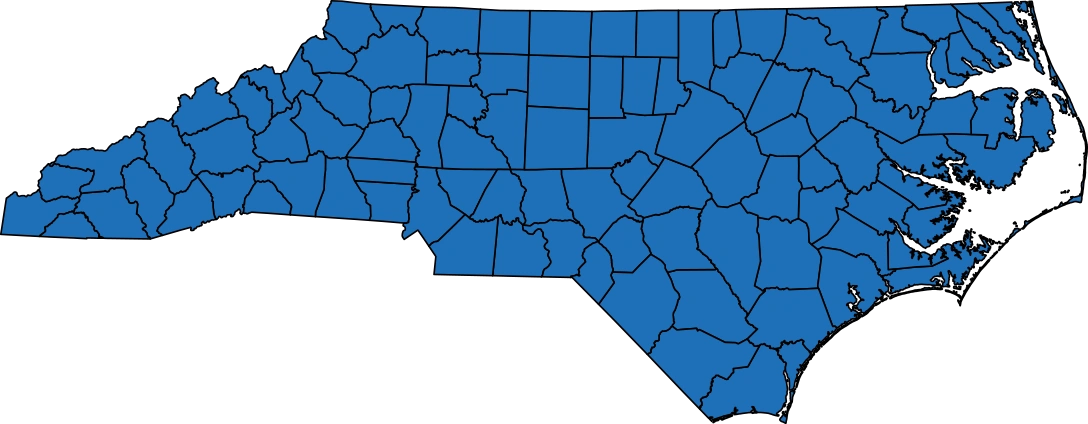
- Serving All of North Carolina
Built on Trust and Results


At Bowman Law PLLC, we are dedicated exclusively to representing injured workers throughout North Carolina. Unlike firms that handle many different practice areas, our focus on workers’ compensation law allows us to provide knowledgeable guidance and personalized representation at every stage of the claims process.
Attorney Joe Bowman is a Board Certified Specialist in Workers’ Compensation Law by the North Carolina State Bar, a distinction earned by only a select number of attorneys statewide. Before founding the firm, he represented insurance companies and employers, providing valuable insight into how claims are evaluated and defended. Today, he uses that experience to advocate for injured workers and help them pursue the benefits they deserve.
From your initial consultation through the resolution of your claim, you will work directly with an experienced attorney who is committed to protecting your rights. Whether your claim has been denied, your benefits have been disputed, or you simply need trusted guidance after a workplace injury, Bowman Law PLLC is here to help you move forward with confidence.
What People Are Saying
I had an excellent experience during my consultation with this attorney. From the very beginning, they were attentive, professional, and genuinely interested in understanding my situation. They took the time
Amazing Law Firm. They are super easy to talk to and stay on top of any issues until they are resolved. Also they are more than willing to listen to
By far the best lawyers and quite frankly best people you can come across. They handled my worker’s comp case and the results were on point. Had some billing issues
These people are extremely helpful and awesome! I was referred to Bowman Law by another attorney, and I’m very satisfied with Bowman Law. They’ve helped me from the day they

Injured Stopping Attempted Robbery

Welder from Falling object

Delivery Driver
Lumbar Spine Injury

Falls/Partial Denial

Multiple Fractures from Falling Object

Crush Injury to the Hand & Arm
At Bowman Law PLLC, we represent injured workers — not insurance companies.

Joe Bowman is a Board Certified Specialist in Workers’ Compensation Law by the North Carolina State Bar.

You only pay if we recover compensation, and all attorney fees are governed by the North Carolina Industrial Commission.

We concentrate solely on workers’ compensation law, giving us deep expertise in this complex area.

Work directly with your attorney — not a case manager. We provide personalized attention to every client.

Extensive experience handling denied and complex claims to ensure you get the benefits you deserve.

Offices in Winston-Salem and Raleigh, serving clients throughout North Carolina.
Across North Carolina

Joseph S. Bowman
Joe Bowman is an attorney with Bowman Law PLLC. The firm serves clients across the the State of North Carolina, as well as individuals who reside beyond the borders of North Carolina who are parties to legal matters within the jurisdiction of the North Carolina Industrial Commission. Joe chooses to focus the vast majority of his work in the area of workers’ compensation law, representing individuals affected by job-related injuries and occupational diseases. He is also a North Carolina Superior Court Mediator, certified by the NC Dispute Resolution Commission.

Allison L. Bowman
Allison Bowman is an attorney with Bowman Law PLLC, as well as a North Carolina DRC Certified Superior Court Mediator. She focuses her time and talents in the area of North Carolina workers’ compensation law. She represents individuals in workers’ compensation claims, including those individuals affected by job-related injuries and occupational diseases. Allison is particularly adept and experienced in the area of alternative dispute resolution, having worked on behalf of individual plaintiffs to mediate many, many workers’ compensation claims to successful resolution.

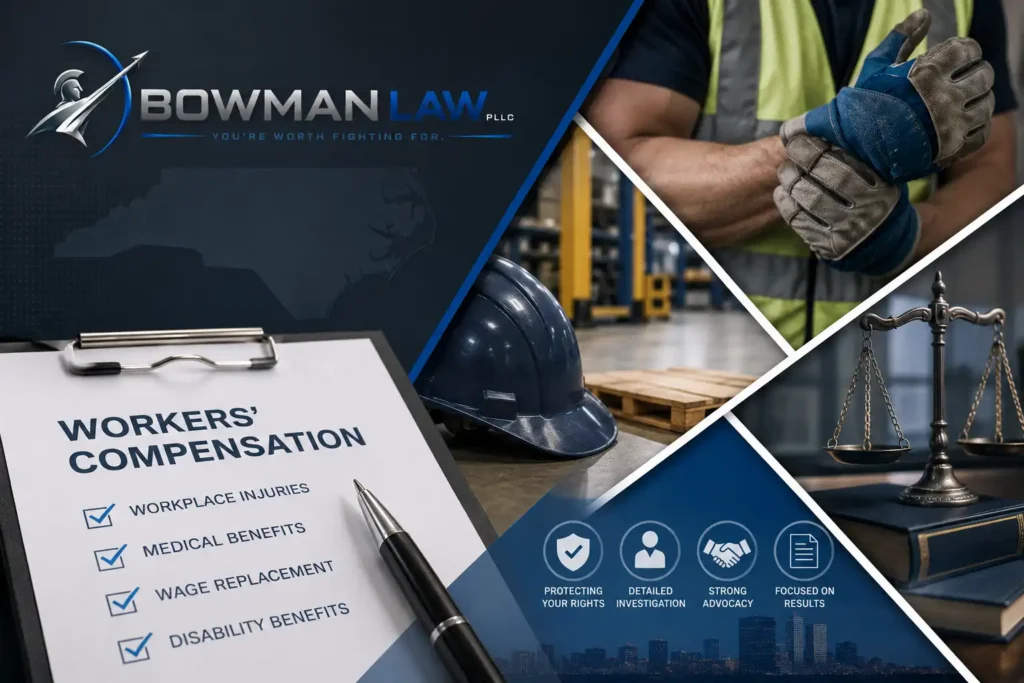
Secure the Benefits They Deserve


injuries


benefits


Compensation


Settlement
What is workers’ compensation?
Worker’s compensation (which can also be called workers comp. or workman comp) was enacted by statute in North Carolina in 1929. As a general rule, each business that has more than three employees must be covered by worker’s compensation insurance.
The system is governed by a state agency called the Industrial Commission.
An employee may be entitled to workers’ compensation benefits when he or she is injured in the course and scope of his or her employment. When each and every element of this claim is proven, workers’ compensation benefits become available to the employee.
An employee must give notice to his employer of an injury on the job by filing a written notice. This notice of an accident should be filed within 30 days of the date of the accident. The absolute limit for filing a written notice is two years.
The injured worker is often taken advantage of because they do not know their rights. Your employer may not tell you of all the rights you have and the insurance company is strictly concerned with minimizing the cost of your claim. This means you may not have all the available information regarding job retraining, overtime pay benefits, wage differential benefits, statute of limitations, notice requirements, repetitive traumas, maintenance payments when being retrained and settlements.
How much does it cost to hire a workers’ compensation attorney?
Generally speaking, workers’ compensation attorneys do not charge upfront fees. They work on a contingency basis, meaning they will receive compensation when you do.
Also, the Industrial Commission has very specific rules regarding attorneys’ fees. It is unlawful for any attorney or other person to accept a fee, gift, or any remuneration for any services rendered in connection with the claim of a worker seeking compensation unless such fee or other consideration has been approved by the Industrial Commission.
Can I sue my employer instead of pursuing a workers’ compensation claim?
In most cases the answer is no. Workers’ compensation systems were established as a tradeoff in which employees gave up the right to sue employers in court for their injuries, in exchange for the right to receive workers’ compensation benefits regardless of who was at fault for their injuries. Most employers are required by law to provide workers’ compensation insurance for the benefit of their employees. In exchange for providing that insurance, employers are protected from defending personal injury claims brought by employees in civil actions.
Who is required to provide workers’ compensation coverage?
Any employer who employs three or more employees.
Any business that meets this requirement is covered by the Workers’ Compensation Act and required by law to obtain insurance or qualify as a self-insured company in order to provide compensation in the event of a liability to their employees.
NOTE: Every executive officer selected or appointed and empowered in accordance with the charter and bylaws of a corporation is considered an employee of such corporation. For example, a corporation with two officers and one employee would be required to provide workers’ compensation coverage. Any employer in which one or more employees are employed in activities which involve the use of or presence of radiation is required to have coverage.
There are certain exceptions to this rule. For example, agricultural employers with fewer than ten (10) regular employees and certain sawmill and logging operators are exempt. Businesses with any employee whose work involves the use of or presence of radiation are required to have coverage.
What types of injuries are covered by workers’ compensation?
Employees are entitled to benefits if, while carrying out activities for the benefit of their employer, they suffer an injury by accident, a “specific traumatic incident,” resulting in a hernia or back injury, or an “occupational disease.” An “accident” is an interruption of the regular work routine and the introduction of unusual circumstances, such as a slip, trip, fall, or other unusual activity, likely to result in unexpected consequences. A “specific traumatic incident,” as defined by our courts, includes “injuries that occur during normal work activities.” The claimant need not show “an instantaneous occurrence” or “an external cause or unusual conditions.” However, “injuries that occur gradually, over long periods of time, are not specific traumatic incidents.” If the work-relatedness of a hernia is disputed, an employee must show that the hernia appeared suddenly following an accident and did not exist prior to the accident or incident. All injuries must “arise out of and in the course and scope of” the covered employment to be compensated.
Businesses complying with the Act and their employees may not be sued in the Courts by employees for work-related injuries, except for intentional assaults and conditions so grossly unsafe as to make injury substantially certain. Businesses may obtain the benefits and protections of the Workers’ Compensation Act by purchasing compensation insurance, by being self-insured, or by joining a self-insurance pool.
What types of injuries typically arise out of and in the course of employment?
Broken or fractured bones, back injuries or pain, knee injuries, grip loss, heart attacks, hypertension, wrist injuries (e.g., carpal tunnel syndrome), burns, shoulder pain, neck pain, headaches, and slip and falls.
What is an occupational disease?
Generally, an employee is entitled to benefits for disability due to a condition to which the employment significantly contributed, or if the employment was a significant factor in causing the disease’s development, and if the employment exposed the worker to a greater risk of contracting the disease than the public generally. Where an employee is exposed to the same injurious agent at the place of business of more than one employer, the claim should be filed with the employer on whose premises he was last injuriously exposed.