


Not every worker in North Carolina is automatically covered by workers’ compensation laws. Certain agricultural workers, domestic employees, independent contractors, and employees of very small businesses may fall outside mandatory coverage requirements under the North Carolina Workers’ Compensation Act.
However, exemptions are not always straightforward, and some workers who are told they are “not covered” may still have legal rights. Employment classification disputes, subcontractor relationships, and employer size can all affect eligibility. Injured workers in Winston-Salem should speak with an experienced workers’ comp attorney to understand whether benefits may still be available after a workplace injury.
Bowman Law PLLC represents injured workers throughout Winston-Salem and North Carolina in workers’ compensation claims, denied benefit disputes, and workplace injury cases. Attorney Joe Bowman focuses on helping workers understand their rights under North Carolina law and navigate the workers’ compensation system after serious injuries.
Understanding Workers’ Compensation Coverage in North Carolina
North Carolina workers’ compensation laws require many employers to carry insurance that provides benefits for employees injured on the job. These benefits may include medical treatment, wage replacement, and compensation for permanent injuries.
In general, businesses with three or more employees are required to carry workers’ compensation insurance. However, several exemptions under state law can create confusion for both workers and employers.
Some workers are entirely excluded from mandatory coverage requirements, while others may still qualify depending on the specific facts of their employment situation.
For injured workers in Winston-Salem, understanding these exemptions can be critical after an accident, especially when an employer or insurance company claims there is no coverage.
Common Workers’ Compensation Exemptions in North Carolina
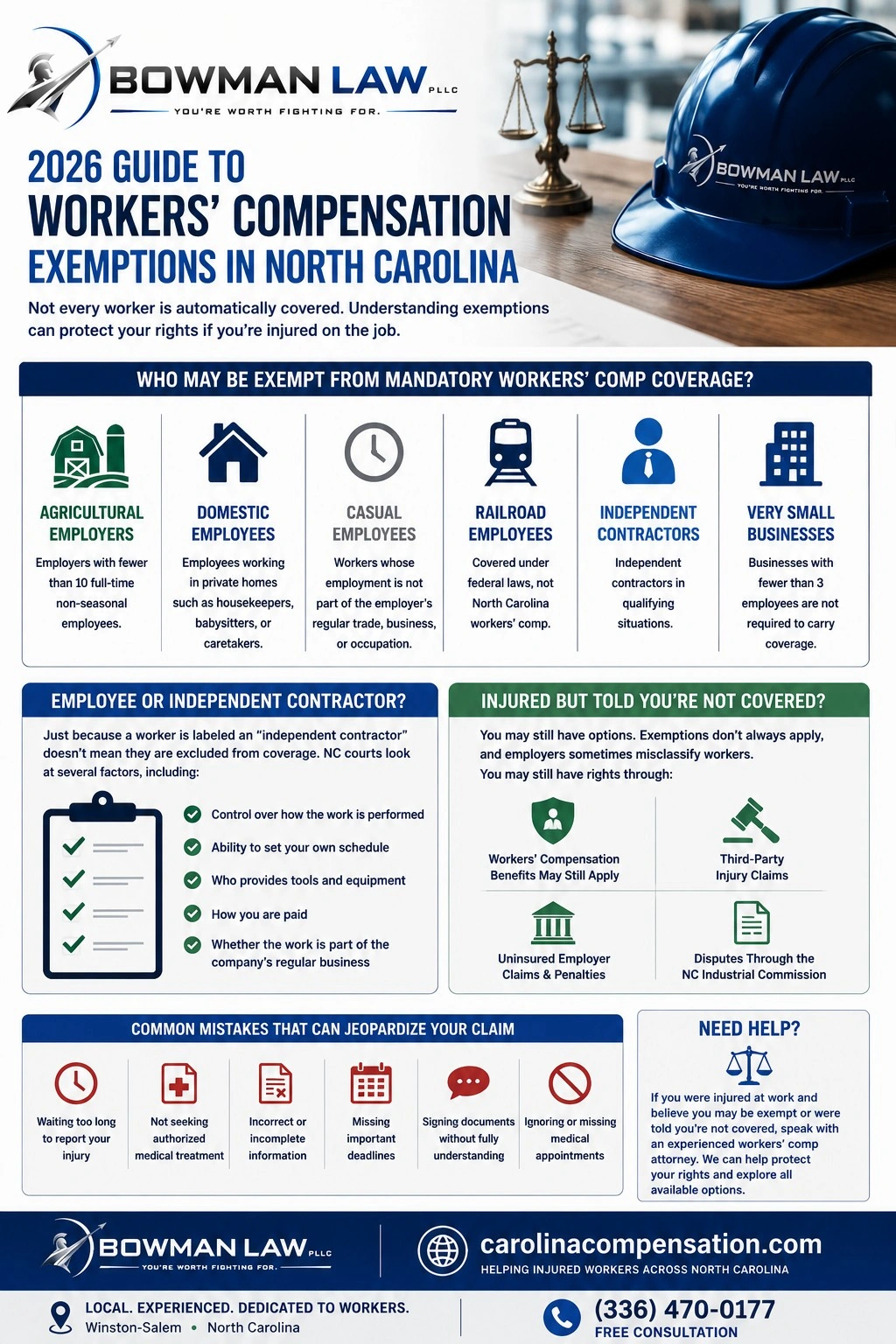
Certain categories of workers are commonly exempt from mandatory workers’ compensation coverage requirements.
These may include:
- Agricultural employers with fewer than 10 full-time non-seasonal workers
- Domestic household employees working in private homes
- Certain casual employees whose work is not part of the employer’s regular business
- Federal laws cover some railroad employees
- Independent contractors in qualifying situations
While these exemptions exist under North Carolina law, determining whether they actually apply often requires a closer review of the worker’s duties, employment structure, and work environment.
In some cases, employers incorrectly classify workers to avoid providing coverage.
Independent Contractors and Misclassification Issues
One of the most misunderstood areas of workers’ compensation law involves independent contractors.
Many companies classify workers as independent contractors instead of employees. However, simply labeling someone an “independent contractor” does not automatically determine legal status under North Carolina law.
Courts and agencies may examine factors such as:
- How much control does the employer exercise over the work
- Whether the worker sets their own schedule
- Who provides equipment or tools
- How the worker is paid
- Whether the work is part of the company’s regular business
Misclassification disputes are especially common in industries involving:
- Construction
- Delivery services
- Transportation
- Gig economy jobs
- Contract labor
A Winston-Salem work injury lawyer can help evaluate whether a worker may still qualify for workers’ compensation benefits despite being classified as an independent contractor.
Agricultural Worker Exemptions in North Carolina
North Carolina has one of the country’s largest agricultural industries and employs thousands of farm workers each year, including seasonal and migrant laborers.
Under North Carolina law, many agricultural employers with fewer than 10 full-time non-seasonal employees are exempt from mandatory workers’ compensation requirements.
However, this exemption does not always mean injured farm workers have no legal options.
Coverage questions may depend on:
- The number of workers employed
- Whether workers are seasonal or full-time
- The nature of the agricultural operation
- Employment relationships involving labor contractors
Because agricultural work often involves heavy equipment, chemical exposure, repetitive labor, and transportation risks, workplace injuries in this industry can be especially serious.
Domestic and Casual Employee Exemptions
Certain domestic workers and casual employees may also fall outside mandatory workers’ compensation coverage requirements.
Examples may include:
- In-home household employees
- Babysitters or caretakers in private homes
- Temporary workers performing irregular tasks outside a business’s normal operations
These cases often depend heavily on the specific facts surrounding the employment arrangement.
Workers may still have legal options in some situations, especially if negligence or unsafe conditions contributed to the injury.
What Happens If an Employer Fails to Carry Coverage?
Some employers are legally required to carry workers’ compensation insurance, but fail to do so.
When this happens, injured workers may still have legal remedies available through:
- Claims involving the North Carolina Industrial Commission
- Potential civil liability claims
- Uninsured employer penalties and enforcement actions
Employers who fail to maintain required workers’ compensation coverage may face serious legal and financial consequences under North Carolina law.
For injured workers, determining whether coverage should have existed often requires reviewing payroll records, employment structures, and business operations.
How Workers’ Compensation Exemption Disputes Arise
Exemption disputes frequently occur after serious workplace accidents when insurers or employers attempt to deny responsibility.
Common disputes involve:
- Whether the worker was truly an employee
- Whether the employer met coverage thresholds
- Whether the injury occurred during work duties
- Whether another insurance policy may apply
Claims involving independent contractors, subcontractors, or temporary workers often become especially complicated.
In Winston-Salem, these disputes can arise in industries ranging from construction and transportation to warehousing and delivery services.
Steps Injured Workers Should Take After an Accident
Even if you are unsure whether workers’ compensation coverage applies, taking the right steps after a workplace injury remains important.
You should:
- Report the injury as soon as possible
- Seek medical treatment immediately
- Document your job duties and work relationship
- Preserve communication with the employer
Workers should avoid assuming they are automatically exempt simply because an employer says so.
Employment classification and workers’ compensation eligibility often involve legal analysis beyond what an employer or insurer initially claims.
How a Winston-Salem Workers Compensation Lawyer Can
Help
Workers’ compensation exemption disputes can quickly become legally complex, especially when employment classification or contractor relationships are involved.
An attorney can help by:
- Reviewing employment relationships and contracts
- Determining whether workers’ compensation laws apply
- Gathering payroll and workplace evidence
- Communicating with employers and insurers
Bowman Law PLLC works with injured workers throughout Winston-Salem and focuses on workers’ compensation claims involving denied benefits, employment disputes, and workplace injuries.
Attorney Joe Bowman helps clients understand their rights and evaluate possible legal options after a workplace accident.
Why Workers Turn to Bowman Law PLLC
Workers dealing with exemption disputes often face uncertainty about medical bills, lost income, and whether benefits are available at all.
Bowman Law PLLC focuses on helping injured workers throughout Winston-Salem navigate workers’ compensation claims and complex employment-related disputes.
Clients receive:
- Clear communication throughout the process
- Guidance regarding employment classification issues
- Representation during disputes and hearings
The firm focuses on helping injured workers understand their rights under North Carolina law and pursue available compensation after workplace injuries.
Take the Next Step
Workers’ compensation exemptions in North Carolina are often more complicated than they first appear. Some workers who are initially told they are not covered may still have important legal rights.
If you suffered a workplace injury and have questions about workers’ compensation coverage or exemptions, Bowman Law PLLC can help you evaluate your situation. Calling (336) 470-0177 can help you understand what legal options may be available.
Frequently Asked Questions
Who is exempt from workers’ compensation in North Carolina?
Certain agricultural workers, domestic employees, casual workers, and some independent contractors may be exempt from mandatory coverage requirements.
Are independent contractors automatically excluded from workers’ compensation?
Not always. Employment classification depends on several legal factors beyond job titles or contracts.
What if my employer says they do not carry workers’ compensation insurance?
You may still have legal options depending on whether the employer was legally required to provide coverage.
Can seasonal farm workers qualify for workers’ compensation?
In some cases, yes. Coverage depends on the employer’s size, worker classification, and employment structure.
Should I speak with a lawyer if my claim was denied because of an exemption?
Yes. Exemption disputes are often complex, and legal guidance may help determine whether workers’ compensation laws still apply.